Research / The life behind the form
A creature is
more than
its shape.
A body, a way of moving, a world to move through. Protobytes grows from the relationships between them.
Behind Ira Greenberg’s imagined organisms is a continuing investigation into computational form, artificial life, and evolutionary search. Walking studies, maze experiments, and material interpretations ask how a set of rules can give rise to something we recognize as a creature.
Enter the experiment notebook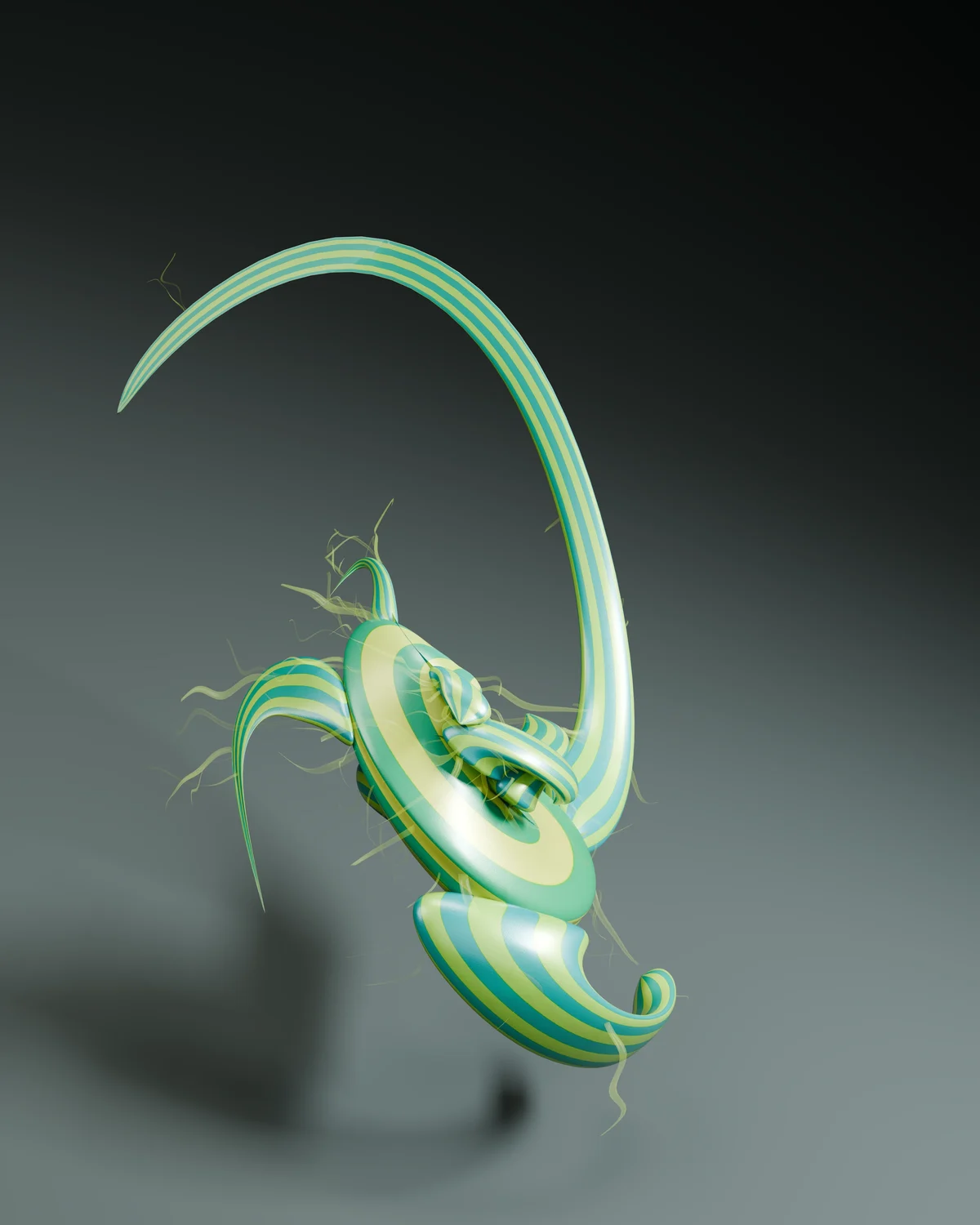
The central inquiry
Form meets
consequence.
What changes when a creature’s body has to do something?
A longer limb changes reach. A heavier body changes acceleration. A slippery surface changes what movement can accomplish. In an evolutionary experiment, inherited differences meet a task and an environment; the resulting performance influences what passes to the next generation.
Protobytes brings this inquiry into an artistic world. Its ambition is an international family of recognizable creatures, artworks, experiences, and objects, with a traceable relationship to the systems that produced them.
Three ways into the work
Ideas. Experiments. Practice.
The science of possible forms.
D’Arcy Thompson, mathematical morphogenesis, genetic algorithms, and evolving virtual creatures.
Follow the scientific connections ↗ 02 / ExperimentsFrom walking to finding a way.
Earlier gait studies, the current navigation lab, initial results, and the next questions about motility.
Read the notebook ↗ 03 / MethodA world with a working record.
How evidence, authorship, and material testing can guide a creature from an experiment into public life.
Explore the working method ↗Different systems, named clearly
What “evolving” means here.
The motion and navigation studies use measured performance to search for controllers across generations. ProtoWorld is a separate artistic ecology in which authored rules and model assessments participate in selection. The studios interpret computational bodies through drawing, color, paper, and other treatments.
These systems have different purposes. A rendered movement, an inherited trait, and an improvement in an experiment each need their own explanation. The notebook identifies what varies, what is measured, and what each result supports.
This section documents an artist’s computational research and development. Published scientific work provides foundations and comparisons; the project studies presented here are preliminary studio experiments.
Read the vocabulary of the work ↗Continue through the research
Scientific foundationsResearch notes · September 25, 2026 · Ira Greenberg’s studio